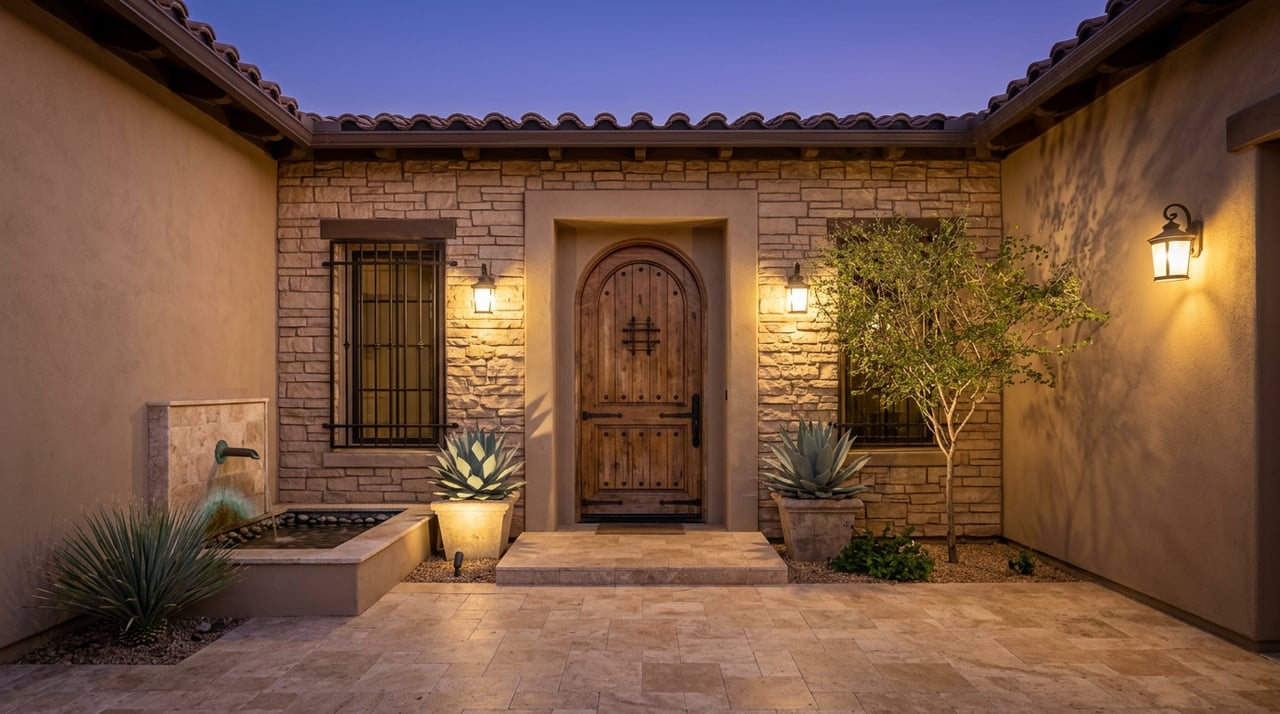
Catalina Foothills Home Prices: What the Median Conceals
September 24, 2026
September 24, 2026
According to Tucson.com, on September 18, a home in The Canyons, a gated enclave off North Campbell Avenue near East Skyline Drive, closed for $8.6 million. It's the highest price ever paid for a home in the Tucson area, according to Long Realty, which handled the sale. The house was built in 2024, runs 8,292 square feet across five bedrooms and 6.5 bathrooms, sits on five acres, and comes with a backyard cave, a full fitness studio, a walk-in safe, and a 16-car garage. The previous record, $8.4 million, had stood since April 2024.
If you've been watching Catalina Foothills listings and comparing them to the median price you see quoted online, that $8.6 million number probably doesn't square with anything you've been shown. That's the point. The median price for Catalina Foothills isn't a snapshot of one market. It's a figure drawn from sales across at least three markets that share a zip code and almost nothing else, and the widening gap between the median and the ceiling is the clearest evidence yet that treating this neighborhood as a single price tier will cost you time, and possibly money, before you ever write an offer.
Depending on which snapshot you pull, the reported median for Catalina Foothills sits somewhere between $612,000 (a January 2026 read from a local brokerage) and $690,000 (a three-month window ending May 2026). Both numbers are directionally consistent. Both are also, on their own, close to useless for a buyer trying to figure out what their budget actually gets them here.
That's because the Foothills median blends condo and townhome sales starting in the $300,000s with single-family acreage homes that rarely list below $900,000, then folds in an ultra-luxury tier, communities like Pima Canyon and Canyon Ranch, where listings routinely run $2 million to $5 million and beyond. Price per square foot across that full spread has been reported anywhere from $262 to $548, which tells you less about the neighborhood's value and more about how many different products are getting counted in the same bucket.
Here's what that segmentation looks like in practice:
| Tier | Typical Price Range | What You're Buying |
|---|---|---|
| Condo / townhome entry | $300K–$700K | Lock-and-leave units, often near Ventana Canyon or La Paloma, smaller footprints, HOA-maintained exteriors |
| Single-family, standard lot | $900K–$1.5M | The realistic floor for a detached home on close to an acre, per current local market guides |
| Ultra-luxury estate | $2M–$5M+ | Custom architecture, larger acreage, communities like Pima Canyon and Canyon Ranch |
A buyer with $1 million to spend and a $612,000 median in their head might expect to be shopping near the top of the market. In reality, they're at the entry point of the single-family tier, competing with buyers who see that price as a starting line, not a ceiling.
The jump from an $8.4 million record in April 2024 to $8.6 million in September 2026 is a two-year, $200,000 move at the very top of the market. Over that same stretch, the neighborhood's median sale price barely moved, some readings show it essentially flat year over year, others show single-digit percentage gains.
That gap matters. It means the ultra-luxury tier in Catalina Foothills is increasingly setting its own pace, disconnected from the pressures that move the median: mortgage rates, days on market, general buyer traffic. A $2 million-plus custom estate on five acres competes against a small pool of cash-strong, often relocating buyers who are comparing Catalina Foothills to Scottsdale or Paradise Valley, not to the rest of Tucson. The median can sit still while the ceiling climbs, because they're responding to different buyers entirely.
If your search budget puts you anywhere near that top tier, the neighborhood median is not a useful anchor. Look instead at recent comparable sales inside the specific community you're considering.
Here's the friction that shows up after a buyer has picked a house and started reading HOA documents, not before.
Catalina Foothills' three best-known golf and club communities, Skyline Country Club, Ventana Canyon, and La Paloma, do not handle club membership the same way. At Skyline, membership is typically required as a condition of ownership. At Ventana Canyon and La Paloma, it's optional. That single distinction can add $15,000 to $25,000 a year in dues that a buyer comparing listing prices alone would never see coming.
Ventana Canyon adds a second layer worth understanding before you write an offer. The community operates under a master association, the Ventana Canyon Community Association, which covers shared elements like the main gate and private roads. Most homes inside a neighborhood sub-association pay dues to both the master association and the sub-association, and club privileges, golf, tennis, dining, are billed separately again through the club itself. A resale package that only shows one HOA fee is showing you part of the picture.
None of this makes these communities a bad choice. Buyers weighing Skyline may also want to consider its clubhouse, course, and social calendar. Ventana Canyon's layered billing pays for a level of shared infrastructure, gated entry, maintained private roads, that a simpler HOA wouldn't cover. The issue isn't the fee structure itself. It's that a buyer who prices a home off the listing and one HOA line item can be off by tens of thousands of dollars a year before they've accounted for property taxes or insurance.
Before you write an offer in any Foothills club community, request the full resale package: master association dues, sub-association dues if applicable, and separate club membership terms including initiation fees. Ask directly whether membership is mandatory, optional, or by invitation. That one question resolves more budget uncertainty than any listing price will.
One more layer worth knowing if you're shopping the single-family tier specifically: age and architectural pedigree carry their own premium here. Catalina Foothills Estates, the neighborhood's oldest section, was shaped in the 1920s by developers John and Helen Murphey working with architect Josias Joesler, whose Spanish Colonial Revival designs became a defining look for the area. Homes with that documented Joesler lineage tend to trade at a 15 to 25 percent premium over comparable square footage elsewhere in the Foothills, purely on architectural provenance.
That means two homes with identical lot size and finishes, one Joesler-attributed and one not, can land in very different places on price. If a listing mentions Joesler or Murphey by name, that's not marketing language you can skip past. It's a specific, verifiable value driver.
The practical takeaway isn't complicated, but it does require abandoning the median as your reference point. Figure out which of the three tiers you're actually shopping, condo, standard single-family, or ultra-luxury, because each behaves like its own market with its own pace and its own competition. If you're looking at a club community, get the full fee structure in writing before you fall in love with a floor plan. And if a listing carries a Joesler or Murphey attribution, treat that as a line item, not a footnote.
The Foothills isn't quietly getting more expensive in any linear way you can extrapolate from a headline median. It's getting wider, with more separation between its entry point and its ceiling, which is exactly what a fresh sales record next to a flat median is telling you.
Worth noting for context, not for your search budget: even amid record-setting sales news, the neighborhood keeps adding to its everyday footprint. Turquoise Wine Bar is set to open in Catalina Foothills on September 25, one more sign that commercial investment here isn't only happening at the eight-figure end of the market.
Does a lower HOA fee always mean lower total housing cost? Not necessarily. A lower HOA fee at a club community may simply mean membership is optional and billed separately. Ask for the combined total of HOA dues, any master association assessment, and club dues before comparing two properties.
Is the ultra-luxury tier realistic for a typical move-up buyer? Communities like Pima Canyon and Canyon Ranch, where listings commonly run $2 million and up, serve a different buyer than the standard single-family tier starting closer to $900,000. Most move-up buyers moving from elsewhere in Tucson will be shopping the middle tier, not the record-setting end of the market.
Does an older home in Catalina Foothills Estates cost more to maintain? Age alone doesn't determine cost, but documented Joesler or Murphey provenance does tend to carry a resale premium, so it's worth confirming architectural history with the listing agent or through neighborhood records before you assume a price is purely a reflection of size or condition.
If you're trying to figure out where your specific budget actually lands in this market, or you want the real fee structure behind a specific club community before you tour, Luxury Signature Group can walk you through both. Start with an instant home valuation if you're weighing a move within the Foothills, or reach out directly if you're ready to talk through which tier fits what you're trying to buy.
This article is general information, not legal, tax or financial advice. Consult a qualified professional about your situation.
Get assistance in determining current property value, crafting a competitive offer, writing and negotiating a contract, and much more. Contact us today.